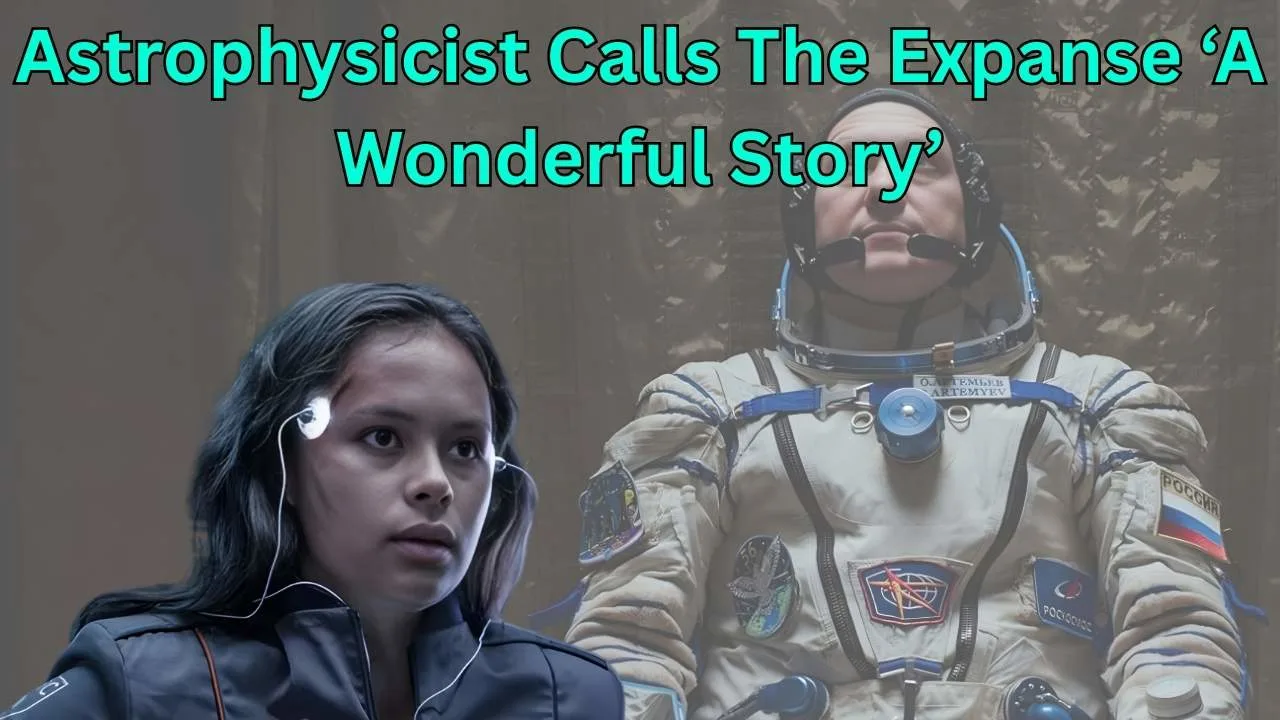
Amazon Prime Video’s The Expanse remains one of television’s most compelling science fiction achievements, a show that combined meticulous world-building, believable technology, and deep political intrigue. Recently, the series received high praise from astrophysicist Paul M. Sutter, who described it as “a wonderful story, complex, intricate, and remarkably grounded for a work of science fiction.”
Sutter made his remarks during Insider’s How Real Is It? video series, where he reviewed various science-fiction films and shows for scientific accuracy. After assessing nine other popular titles, he named The Expanse as his personal favourite depiction of space society and physics on screen.
“There are some non-realistic, magical elements,” Sutter explained, “but they work really hard to set up the physics correctly — and more importantly, to imagine what society would look like in space. I really appreciate that.”
His comments have reignited interest in The Expanse, prompting new fans and long-time viewers alike to revisit the six-season epic that has become a benchmark for “hard sci-fi” storytelling.
Introduction to The Expanse: A Realistic Vision of Humanity’s Future
Developed by Mark Fergus and Hawk Ostby, The Expanse was inspired by the bestselling novels written by James S. A. Corey (the pen name for authors Daniel Abraham and Ty Franck). The show first premiered on Syfy in 2015 before finding a lasting home on Amazon Prime Video, where it concluded its six-season run in 2022.
Set hundreds of years in the future, the story explores a time when humanity has colonized much of the Solar System. The series delves into the fragile balance of power between three major factions:
- The United Nations of Earth and Luna (The Inner Planets)
- The Martian Congressional Republic (Mars)
- The Outer Planets Alliance (OPA), a loose coalition of Belters struggling under economic and political oppression.
The series begins with a noir-style mystery, as detective Joe Miller (played by Thomas Jane) investigates the disappearance of a woman named Julie Mao. This seemingly small case unravels into a massive interplanetary conspiracy involving alien technology, political corruption, and humanity’s struggle for survival and freedom.
Overview: The Expanse
| Aspect | Details |
|---|---|
| Series Title | The Expanse |
| Platform | Amazon Prime Video |
| Original Premiere | December 14, 2015 (Syfy) |
| Final Season | Season 6 (2022) |
| Creators | Mark Fergus, Hawk Ostby |
| Based On | The Expanse novels by James S. A. Corey |
| Genre | Science Fiction / Space Drama |
| Total Episodes | 62 |
| Critical Rating | 95% on Rotten Tomatoes |
| Expert Praise | Paul M. Sutter, Astrophysicist: “A wonderful story, scientifically thoughtful.” |
Why Scientists Love The Expanse: A Grounded Approach to Space?
One of the show’s most praised aspects is its scientific accuracy. Unlike most space operas, The Expanse treats physics as a real constraint, not a cinematic convenience. From its depiction of zero-gravity movement to the use of acceleration drugs to withstand G-forces, the series aims to make space travel feel authentic.
Astrophysicist Dr. Paul Sutter emphasized:
“What’s impressive is how The Expanse doesn’t ignore the limits of space — it embraces them. The creators understand that living in space would be as much about sociology and biology as technology.”
The show’s attention to realism extends beyond science. It explores the socioeconomic inequality that would inevitably shape interplanetary civilisation, depicting how the outer colonies vital for mining and resources become exploited by Earth and Mars.
Societal and Political Realism in Space
In The Expanse, humanity’s expansion into the Solar System mirrors the colonial and political struggles of history. Earth remains overpopulated and bureaucratic; Mars is militarised, disciplined, and ambitious; and the Belters born and raised in low gravity form the underclass of the system.
The political allegory has earned praise from experts in international relations. Political analyst Dr. Serena Hodge notes:
“The Expanse is one of the few shows that understands how power operates — who controls resources, who gets exploited, and how technology reshapes geopolitics. It’s not just science fiction; it’s political science fiction.”
The Expanse’s Awards and Critical Acclaim
During its six-season run, The Expanse received dozens of nominations and won eight major industry awards, including Saturn Awards for Best Science Fiction Television Series. It also achieved an impressive 95% critic rating and 85% audience score on Rotten Tomatoes, solidifying its reputation as one of the best sci-fi shows ever made.
| Category | Recognition |
|---|---|
| Rotten Tomatoes Score | 95% Certified Fresh |
| Audience Score | 85% |
| Industry Awards | 8 wins, including Saturn and Hugo Awards |
| Notable Praise | Realistic physics, strong writing, diverse ensemble cast |
| Streaming Platform | Amazon Prime Video |
Entertainment writer Mark Elliott called it:
“The Battlestar Galactica of its generation — intelligent, daring, and scientifically literate.”
Ending Explained: Leaving Room for More
Although The Expanse ended in 2022, showrunner Naren Shankar revealed that the finale was designed to leave the door open for future stories.
“In a larger Season 6, if we had ten episodes, we might have told that storyline differently,” Shankar explained. “But we wanted to leave room for another chapter, or maybe a sequel someday.”
The creative team purposely concluded with unresolved elements, especially regarding the mysterious alien “ring builders” and the evolving alliances between Earth, Mars, and the Belt. This approach mirrors the open-ended nature of the original novels, which continue well beyond the events of the show.
The Legacy Continues: The Expanse: Dragon Tooth
The universe of The Expanse expanded again in 2023, when BOOM! Studios launched The Expanse: Dragon Tooth, a canonical comic book sequel that bridges the gap between the show’s finale and the seventh novel, Persepolis Rising.
| Comic Title | The Expanse: Dragon Tooth |
|---|---|
| Publisher | BOOM! Studios |
| Writer | Andy Diggle |
| Artist | Rubine |
| Timeline | Between TV finale and Persepolis Rising |
| Purpose | Expands post-series narrative and character arcs |
Fans and critics welcomed the comic as a satisfying continuation, offering hope that Amazon might one day revisit The Expanse universe in live-action form.
Why The Expanse Still Matters?
Even years after its finale, The Expanse continues to resonate because it achieves something few sci-fi stories manage it make space feel real. The show portrays interplanetary life not as fantasy but as an extension of human struggle: the fight for identity, survival, and justice.
Cultural commentator Renee Wallace summarizes its impact:
“What makes The Expanse timeless is its honesty. Space isn’t romanticized; it’s dangerous and political. Yet, amid the darkness, it still finds hope in human resilience.”
The series set a new benchmark for scientifically responsible storytelling, proving that science fiction can be both intellectually rigorous and emotionally gripping.
FAQs
Astrophysicist Paul M. Sutter called it “a wonderful story” and praised its realistic physics and social imagination.
It’s set in a future where humanity has colonized the Solar System, following the political and social tensions between Earth, Mars, and the Belt.
The series ran for six seasons from 2015 to 2022, totalling 62 episodes.
Yes. It’s widely regarded as one of the most scientifically grounded sci-fi series ever produced, using real physics concepts and plausible technology.
While there are no confirmed plans for a new season, BOOM! Studios’ Dragon Tooth comic continues the story between the show and later novels.
All six seasons are available for streaming on Amazon Prime Video.
