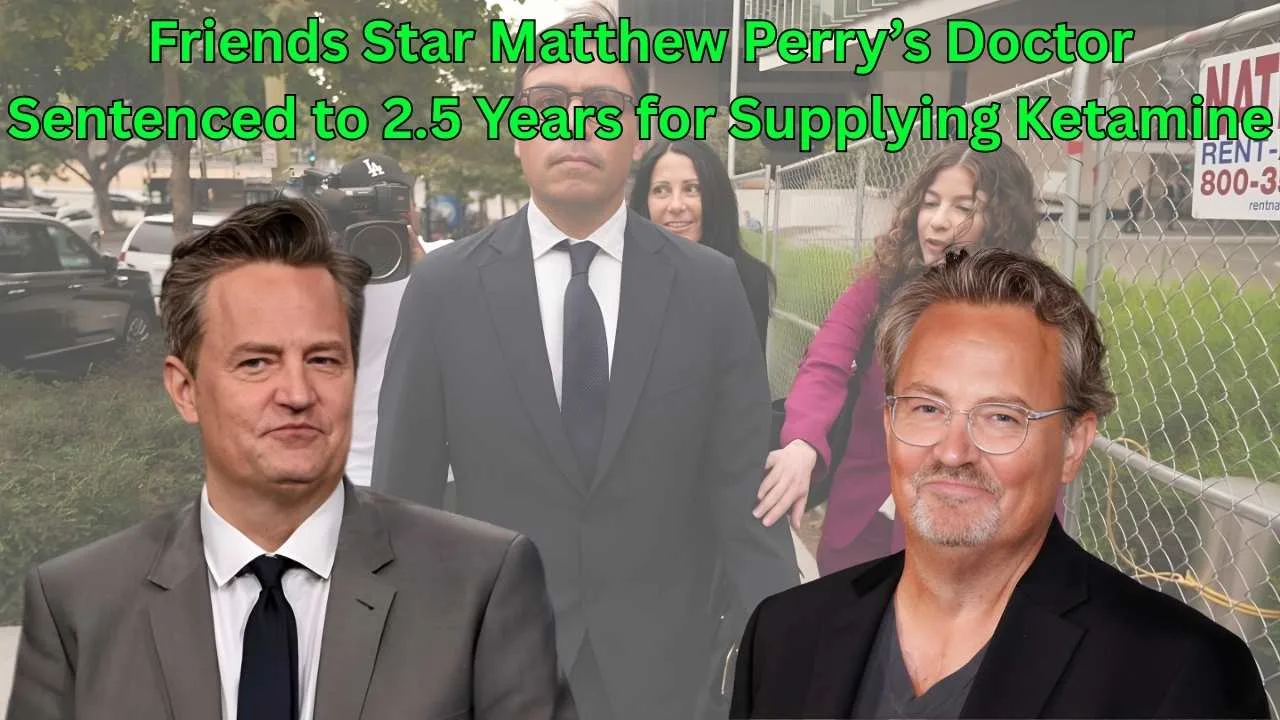
Nearly two years after Friends star Matthew Perry’s tragic death, the doctor who illegally sold him ketamine has been sentenced to prison. On December 3, 2025, Dr Salvador Plasencia, 44, was sentenced to two and a half years in federal prison, followed by two years of probation and a $5,600 fine, in an emotional hearing at a Los Angeles federal courthouse.
Judge Sherilyn Peace Garnett made it clear that while Plasencia was not directly responsible for the lethal dose that caused Perry’s death in October 2023, he played a significant role in fueling the actor’s addiction. “You and others helped Mr. Perry on the road to such an ending by continuing to feed his ketamine addiction,” Garnett told him. “You exploited Mr. Perry’s addiction for your own profit.”
Plasencia, wearing a gray suit, was handcuffed and taken into custody immediately after sentencing as his mother cried softly in the gallery.
Overview of the Case
| Category | Details |
|---|---|
| Defendant | Dr. Salvador Plasencia, 44 |
| Charges | Four counts of distribution of ketamine |
| Sentence | 2.5 years in prison, 2 years probation, $5,600 fine |
| Judge | Sherilyn Peace Garnett |
| Court | Federal Court, Los Angeles |
| Connection to Matthew Perry | Sold ketamine illegally to Perry |
| Victim’s Death | Matthew Perry died in October 2023 from ketamine overdose at age 54 |
| Prosecution Request | 3 years imprisonment |
| Defense Request | 1 day in jail plus probation |
| Verdict Date | December 3, 2025 |
Inside the Emotional Hearing
Before the sentencing, Perry’s family members, including his mother Suzanne Perry, stepfather Keith Morrison, and sister Madeline Morrison, delivered emotional impact statements that moved the courtroom to tears.
“My brother’s death turned my world upside down,” said Madeline Morrison, crying as she addressed the court. “It punched a crater in my life. His absence is everywhere. The world mourns my brother; he was everyone’s favourite friend.”
Suzanne Perry, her voice trembling, confronted the doctor directly: “You called him a ‘moron.’ There is nothing moronic about that man. He was even a successful drug addict.” She paused, visibly shaken, before adding, “This was a bad thing you did.”
At one point, Keith Morrison, the Dateline journalist and Perry’s stepfather, stood beside Suzanne as she spoke, offering quiet support.
Perry’s Legacy and Struggles
Matthew Perry, best known for his decade-long portrayal of Chandler Bing on Friends (1994–2004), struggled with addiction for much of his adult life. He had spoken openly about his battle with painkillers and alcohol, often using his fame to raise awareness about recovery and mental health.
His memoir, Friends, Lovers, and the Big Terrible Thing, published in 2022, detailed his near-death experiences and lifelong recovery journey. In it, Perry wrote, “If I die, I don’t want Friends to be the first thing mentioned I want helping people to be.”
Tragically, Perry’s final years saw him continuing to seek treatment through unconventional means, including ketamine infusions, a therapy sometimes used for depression and pain management. Prosecutors said Plasencia exploited that treatment trend, selling ketamine to Perry privately without proper medical oversight.
What the Judge Said?
Judge Garnett emphasized that while Plasencia was not charged with causing Perry’s death, his actions “paved the way” for the actor’s fatal addiction spiral.
“You took advantage of a vulnerable person who trusted you,” she said. “Mr. Perry deserved better not because he was famous, but because he was human.”
The judge acknowledged that the recommended sentencing guidelines suggested 8 to 14 months, but she opted for a harsher penalty, citing Plasencia’s “abuse of trust” as a medical professional.
When defense attorneys questioned whether the court misunderstood aspects of the case, Garnett replied firmly: “No, I am not confused. Mr. Plasencia was literally offering to sell ketamine.”
Prosecutors vs. Defense
Prosecutors described Plasencia as “a drug dealer in a white coat,” emphasising that he had never acted as a legitimate physician in his dealings with Perry. Assistant U.S. Attorney Ian Yanniello said, “He wasn’t a negligent or reckless medical provider. He was a drug dealer in a white coat.”
Meanwhile, defence attorney Karen Goldstein argued that Plasencia’s actions were a product of “bad judgment clouded by money,” not malice. “It was a perfect storm of bad decision-making,” she said. “Everybody agrees his judgment was clouded by greed.”
The defense requested leniency, suggesting just one day in jail and probation, citing Plasencia’s background as a man who rose from poverty to become a respected physician. But the judge rejected the plea, insisting the crime’s gravity warranted real prison time.
The Defendant’s Emotional Apology
Before being led away, Plasencia broke down in tears, apologizing directly to Perry’s family. “I should have protected him,” he said. “I can’t believe I’m here. I imagine the day I’ll have to tell my 2-year-old son about the time I didn’t protect another mother’s son. It hurts me so much.”
His apology drew silence from the courtroom, but Perry’s family did not appear moved. Outside, Plasencia’s mother, Luz, also expressed remorse. “I’m sorry to the family of Matthew Perry,” she told reporters. “I’m feeling what they feel. I know my son’s heart.”
Prosecutors’ Case: Exploiting a Vulnerable Star
The prosecution painted a grim portrait of Plasencia as someone who preyed on Perry’s struggles for personal gain. Court documents revealed text messages in which Plasencia mocked the actor, calling him a “moron” and discussing his addiction with another doctor.
“He exploited a man who was fighting for his life,” prosecutors said. “Rather than helping him recover, he profited from his pain.”
Plasencia’s illegal sales reportedly occurred after Perry’s legitimate doctor refused to provide higher doses of ketamine. Instead of following ethical guidelines, Plasencia supplied the drug in exchange for cash, often under the pretense of continued “therapy.”
The Legal Context and Future Cases
Plasencia is the first of five defendants to be sentenced in connection with Perry’s death. The remaining four, who reached plea agreements, will face separate hearings in early 2026. Judge Garnett stated she will ensure “sentences are consistent and proportional” among all defendants.
| Defendants in Perry Case | Status |
|---|---|
| Dr. Salvador Plasencia | Sentenced to 2.5 years in prison (Dec 2025) |
| Defendant 2 | Awaiting sentencing (early 2026) |
| Defendant 3 | Awaiting sentencing |
| Defendant 4 | Awaiting sentencing |
| Defendant 5 | Awaiting sentencing |
Although Plasencia was not convicted of causing Perry’s death, the judge’s remarks suggested a shared responsibility among those who supplied the actor with illegal substances.
Family Reactions After Sentencing
After the hearing, Keith Morrison told reporters he believed the sentence was fair. “I think the judge was very well-reasoned,” he said.
Perry’s mother, visibly emotional, added that justice had been served but that no sentence could heal the loss. “You can’t measure the pain of losing your child,” she said softly. “Matthew was more than a celebrity he was my son.”
Outside the courthouse, dozens of fans gathered holding signs reading “Justice for Matthew.” Some wore T-shirts with the Friends logo and Perry’s famous line, “Could I BE any more missed?”
Why This Case Matters?
The sentencing of Dr. Plasencia highlights growing concerns about celebrity addiction treatment, particularly involving alternative or experimental therapies like ketamine. Perry’s death, investigators said, underscores how medical professionals can become enablers rather than healers when ethics are abandoned for profit.
Addiction specialist Dr. Alan Reiner noted,
“Matthew Perry’s case isn’t just about fame — it’s about accountability in medicine. Doctors have a duty to heal, not to sell hope in a syringe.”
FAQs
No. The court determined that he sold Perry ketamine but did not supply the fatal dose.
He pleaded guilty to four counts of ketamine distribution in July 2025.
2.5 years in prison, 2 years of probation, and a $5,600 fine.
They delivered emotional statements in court, condemning Plasencia’s actions as exploitation of a vulnerable person.
Yes. Four additional defendants have pleaded guilty and await sentencing in early 2026.
Perry died in October 2023 at age 54 due to a ketamine overdose.
