In an era where Netflix continues to redefine cinematic storytelling, few films have challenged audiences quite like I’m Thinking of Ending Things (2020). Released quietly during a global shutdown, the film arrived at a time when viewers sought comfort but found instead a disorienting, haunting masterpiece that demanded introspection.
Directed by Charlie Kaufman, known for his cerebral explorations of identity and existence, this psychological thriller stars Jessie Buckley and Jesse Plemons in performances that critics now consider among the finest of their generation. Though underappreciated at release, the film has aged into one of Netflix’s most compelling hidden gems, earning renewed attention amid the awards buzz for both Buckley (Hamnet, 2026) and Plemons (Bugonia, 2026).
As film scholar Nadia Reynolds notes,
“Few Netflix originals have matched the existential weight and artistry of Kaufman’s work. ‘I’m Thinking of Ending Things’ remains a cinematic riddle—unsettling, profound, and unforgettable.”
Introduction to the Film: “I’m Thinking of Ending Things”
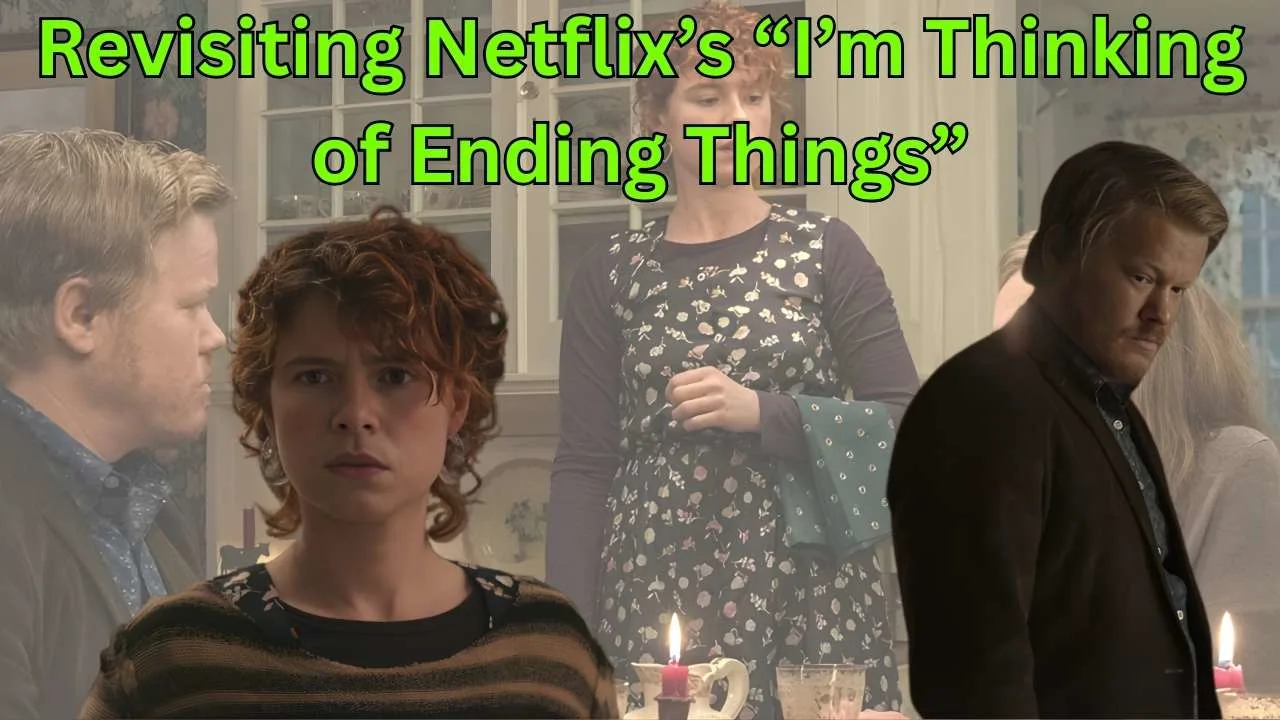
Released in 2020, I’m Thinking of Ending Things is a psychological drama-thriller written and directed by Charlie Kaufman, adapted from Iain Reid’s 2016 novel of the same name. The film follows a young woman (Jessie Buckley) who takes a road trip with her boyfriend Jake (Jesse Plemons) to meet his parents (Toni Collette and David Thewlis) at their remote farmhouse.
What begins as a quiet relationship drama spirals into a deeply unsettling journey through time, memory, and the human mind. Kaufman uses surreal imagery, nonlinear storytelling, and poetic dialogue to blur the lines between perception and reality.
Overview Table – “I’m Thinking of Ending Things”
| Aspect | Details |
|---|---|
| Title | I’m Thinking of Ending Things |
| Genre | Psychological Thriller / Drama |
| Director | Charlie Kaufman |
| Writer | Charlie Kaufman (based on the novel by Iain Reid) |
| Lead Cast | Jessie Buckley, Jesse Plemons, Toni Collette, David Thewlis |
| Release Year | 2020 |
| Runtime | 134 minutes |
| Platform | Netflix |
| Filming Locations | New York, USA |
| Language | English |
| Notable Themes | Identity, Isolation, Memory, Reality vs. Fantasy |
The Story: A Psychological Labyrinth
At its core, I’m Thinking of Ending Things is not a story meant to be solved; it’s meant to be felt. The film begins with Buckley’s character contemplating breaking up with Jake as they drive through a snowstorm to visit his parents. The mundane trip soon morphs into a nightmarish sequence of shifting timelines, changing appearances, and surreal monologues.
At Jake’s family home, time becomes elastic, parents age and de-age within scenes, conversations loop back on themselves, and the boundaries between characters dissolve entirely. By the film’s end, it’s clear that the story is not linear, but psychological, perhaps taking place entirely within Jake’s fragmented consciousness.
Film critic Daniel Mercer observes,
“The film is less about what happens and more about what it means to remember, to regret, and to live with the haunting echoes of unfulfilled dreams.”
Key Performances: Jessie Buckley & Jesse Plemons
The strength of Kaufman’s abstract vision relies heavily on his two leads, and both deliver unforgettable performances that anchor the film’s surrealism.
Jessie Buckley as “The Young Woman”
Buckley brings emotional depth and vulnerability to her character, who remains unnamed throughout the film, a deliberate choice that symbolises her dissolving sense of self. Her performance captures the anxiety of intellectual insecurity, the loneliness of introspection, and the quiet terror of realising that reality may be slipping away.
Critic Marcia Holloway writes,
“Jessie Buckley turns uncertainty into art. Her eyes tell stories even when the script refuses to clarify them.”
Jesse Plemons as “Jake”
Plemons’ portrayal of Jake is equally riveting. At first, he seems like a mild-mannered boyfriend, but subtle gestures and uneasy silences hint at something darker. His character is steeped in repression, loneliness, regret, and delusion merge as he becomes both protagonist and unreliable narrator.
Film analyst Elliot Chen describes it best:
“Plemons is a master of emotional ambiguity. His performance is like a mirror—one moment reflective, the next shattered.”
Together, Buckley and Plemons transform what could have been an intellectual exercise into a profoundly human experience.
Cinematic Techniques and Themes
Charlie Kaufman’s direction blends cinematic surrealism with literary introspection. Each scene is constructed to evoke unease, snow-covered roads, flickering lights, and shifting voices. The cinematography by Łukasz Żal (known for Cold War and Ida) enhances the film’s claustrophobic mood, with cold colour palettes and confined framing emphasising the characters’ mental isolation.
Key themes include:
- The Fragility of Identity: Characters shift names, jobs, and appearances, reflecting the instability of self-perception.
- Memory and Regret: The film’s looping structure mirrors how memory distorts reality.
- Art as Reflection: Kaufman integrates poetry, musical theater, and film references, turning the movie into a dialogue about art’s role in defining who we are.
Thematic Breakdown
| Theme | Depiction in Film |
|---|---|
| Identity | The young woman’s changing name and persona |
| Time | Non-linear narrative, temporal distortions |
| Reality vs. Illusion | Blending of dreams, memories, and present moments |
| Loneliness | Isolated farm setting and internal monologues |
| Regret | Jake’s suppressed desires and failures |
| Art & Memory | Use of paintings, poetry, and performance sequences |
Critical Reception and Legacy
Upon its release, I’m Thinking of Ending Things received mixed-to-positive reviews. Some viewers praised its ambition and artistry, while others found it impenetrable. Yet, over time, it has earned cult status among cinephiles and scholars as one of Kaufman’s most profound works.
Critics lauded the film for its performances and philosophical depth:
- The Guardian called it “an exquisite study in melancholy and meaning.”
- IndieWire praised Kaufman’s courage in defying narrative convention.
- Variety noted that Buckley and Plemons “elevate abstraction into emotional poetry.”
Today, with both lead actors garnering awards recognition for new projects, their earlier collaboration in I’m Thinking of Ending Things is being rediscovered by audiences who missed it the first time around.
Comparison with Other Charlie Kaufman Works
| Film | Year | Theme | Tone | Viewer Experience |
|---|---|---|---|---|
| Being John Malkovich | 1999 | Identity & Consciousness | Surreal Comedy | Absurd but accessible |
| Synecdoche, New York | 2008 | Life & Mortality | Tragic Drama | Emotionally draining |
| Anomalisa | 2015 | Loneliness & Connection | Animated, existential | Intimate and delicate |
| I’m Thinking of Ending Things | 2020 | Reality & Memory | Psychological Thriller | Deeply unsettling and introspective |
This comparison shows that I’m Thinking of Ending Things serves as a culmination of Kaufman’s lifelong themes identity, creativity, and the futility of understanding existence fully.
Recent Updates and Renewed Interest
As of late 2025, I’m Thinking of Ending Things is experiencing a resurgence in viewership. With Jessie Buckley earning awards buzz for Hamnet and Jesse Plemons acclaimed for Bugonia, Netflix has prominently refeatured the film in its “Psychological Thrillers” category.
This renewed visibility has sparked new discussions about Kaufman’s filmmaking style and how his existential storytelling foreshadowed the growing appetite for complex narratives in streaming cinema.
Why It Matters?
In retrospect, I’m Thinking of Ending Things stands as one of Netflix’s boldest creative risks. It broke conventions by refusing to provide easy answers or emotional closure. Instead, it invited audiences into a cerebral experience that rewards reflection and repeat viewing.
The film’s legacy lies not in its plot but in its emotional truth it captures the quiet despair of human thought, the chaos of introspection, and the endless search for meaning.
As film critic Julian Porter puts it, “Kaufman’s film isn’t about ending things, it’s about how we live with what never ends: our minds.”
FAQs
It follows a young woman who visits her boyfriend’s parents, only to descend into a surreal journey questioning identity, memory, and reality.
Jessie Buckley and Jesse Plemons lead the cast, supported by Toni Collette and David Thewlis.
Charlie Kaufman, known for Being John Malkovich and Adaptation.
Yes, it’s adapted from Iain Reid’s novel of the same name.
It is streaming exclusively on Netflix.
The film uses nonlinear storytelling, shifting perspectives, and metaphorical imagery to explore the human psyche.
