For nearly 60 years, Star Trek has inspired scientists, engineers, and dreamers with its vision of humanity’s future among the stars. But not every warp core pulse or subspace anomaly withstands scientific scrutiny.
Recently, astrophysicist Paul M. Sutter, an expert on cosmic voids, revisited a 24-year-old episode of Star Trek: Voyager and his verdict was blunt. According to Sutter, only a single word from the episode had any scientific basis.
“A ‘graviton’ is a real word,” Sutter said, “but that’s about the only accurate part of the entire sequence.”
The episode in question centres around the Voyager crew entering a mysterious “void”, an empty expanse of space without stars or galaxies. While the concept sounds dramatic, Sutter pointed out that the show’s portrayal had little to do with how real cosmic voids behave.
The Episode That Challenged Science: Voyager’s “The Void”
Overview Table – Key Facts About Star Trek: Voyager: The Void
| Aspect | Details |
|---|---|
| Series | Star Trek: Voyager |
| Episode Title | “The Void” (Season 7, Episode 15) |
| Original Air Date | February 14, 2001 |
| Writers | Rick Berman, Michael Piller, Jeri Taylor |
| Main Cast | Kate Mulgrew, Robert Beltran, Tim Russ, Jeri Ryan, Ethan Phillips |
| Premise | The Voyager crew is trapped in a vast, starless void with other ships, struggling to find a way out |
| Scientific Focus | Gravitational voids and cosmic anomalies |
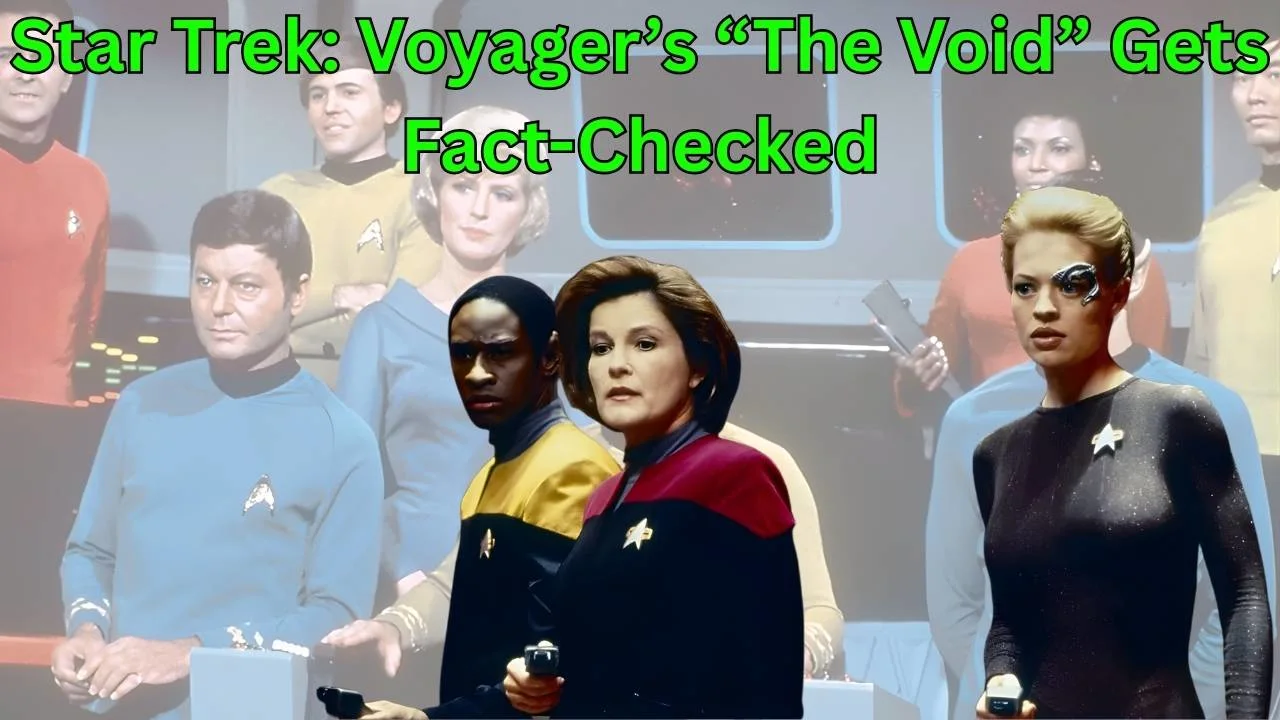
In the episode, Captain Janeway and her crew enter what they believe is a region of space devoid of all stars and planets a “cosmic void.” Inside, they find themselves cut off from energy sources and light, surrounded by other stranded ships.
The episode plays out as a moral allegory about cooperation and survival, hallmarks of Star Trek storytelling. But when viewed through the lens of astrophysics, it’s less “science fact” and more “science fiction.”
What Real Astrophysics Says About Cosmic Voids?
Sutter, who is among the world’s leading authorities on cosmic voids, explained that the show’s depiction of the phenomenon misses several key details about what voids actually are.
“If you were approaching a void, it would actually be the opposite of a surge,” Sutter said. “There’s less matter, less gravity — not more.”
In other words, instead of being a dangerous, mysterious anomaly pulling ships inward, a real cosmic void would be space, vast, quiet, and uneventful.
Sutter continued:
“They have almost no matter within them. If our solar system were placed inside a real void, you wouldn’t see any stars in the sky. Even the nearest galaxies would be millions of light-years away — far beyond the reach of ordinary telescopes.”
To put that in perspective, the episode’s “void” is said to have a circumference of nine light-years. In contrast, Sutter explained that the smallest real voids are about 20 million light-years across.
That’s a difference of nearly two million times larger than what Voyager depicted.
The One Word Voyager Got Right: “Graviton”
Despite the scientific inaccuracies, Sutter gave credit where it was due for one word.
“A graviton is a real term,” he said, “used in theoretical physics to describe the hypothetical quantum particle that mediates gravity.”
In theoretical models, gravitons are the quantum equivalent of gravitational force similar to how photons carry electromagnetic energy. However, no experiment has yet confirmed their existence.
That single correct term was enough to amuse Sutter, who joked, “That’s probably the only thing they got right.”
Still, for fans of Star Trek, scientific realism has never been the point. The franchise’s goal has always been to use speculative science to explore humanity’s moral and philosophical dilemmas, not to predict astrophysical precision.
Fans Fire Back: “It’s a Pocket Dimension, Not a Real Void”
Following Sutter’s critique, Star Trek fans quickly defended the episode online, arguing that it was never meant to portray a scientifically accurate cosmic void.
As one fan pointed out, Voyager’s version of the “void” is described in the episode as a pocket dimension, not a standard region of space. In Star Trek canon, pocket dimensions operate outside normal physics, meaning the show’s writers weren’t even trying to depict real astrophysics.
Longtime Trekkie Lydia Moreno wrote,
“Star Trek’s void isn’t supposed to be a real one — it’s more like a dimension between universes. That’s why ships can get trapped there.”
Still, even those defenses couldn’t erase the humor in an expert taking Star Trek’s science literally. For many, Sutter’s comments became a fun reminder of how science fiction often walks the line between creative imagination and scientific exaggeration.
The Real “Void” Between Science and Storytelling
Science consultant Dr Brian Kross defended Star Trek’s broader legacy, saying the franchise has done more to inspire scientific curiosity than to mislead it.
“The accuracy isn’t the point — it’s the inspiration,” Kross noted. “For every scientific error, Star Trek has sparked ten real discoveries or careers in science.”
Indeed, Star Trek’s imaginative science has influenced generations of innovators from NASA engineers to AI researchers. The show inspired concepts such as tablet computers, medical scanners, and automatic doors, all of which became reality long before.
While the “void episode” might not meet astrophysical standards, it continues to serve its narrative purpose, showing how cooperation and intellect triumph even in the darkest reaches of the galaxy.
Star Trek: Voyager’s Legacy Still Endures
Star Trek: Voyager at a Glance
| Aspect | Details |
|---|---|
| Total Seasons | 7 |
| Total Episodes | 172 |
| Original Network | UPN (1995–2001) |
| Awards | 70 nominations, 20 wins |
| Rotten Tomatoes Rating | 77% (Fresh) |
| Lead Actor | Kate Mulgrew as Captain Kathryn Janeway |
Created by Rick Berman, Michael Piller, and Jeri Taylor, Star Trek: Voyager ran from 1995 to 2001. It was the first Star Trek series to feature a female captain as its lead, and it helped expand the franchise’s universe into new moral and scientific territories.
Even two decades later, Voyager remains beloved among Trekkies. Its combination of deep-space exploration, ethical dilemmas, and character-driven stories continues to attract new audiences through streaming platforms.
The Future of Voyager: A Return Through Comics
While the show ended nearly 25 years ago, Voyager’s story isn’t over. In 2024, IDW Publishing launched Star Trek: Voyager – Homecoming, a new comic series celebrating the show’s 30th anniversary.
Comic Overview – Voyager: Homecoming #1
| Publisher | IDW Publishing |
| Writers | Susan and Tilly Bridges |
| Artist | Ángel Hernández |
| Premise | The Voyager crew returns to Earth after years in the Delta Quadrant — only to uncover a deadly new secret. |
The comic picks up immediately after the series finale, reuniting Captain Janeway and her crew as they face a final challenge. It’s a nostalgic return for fans who have followed Voyager’s journey since its debut on UPN in the 1990s.
Why Star Trek Still Matters?
While astrophysicists like Paul M. Sutter may laugh at the show’s “bad science,” Star Trek’s influence on real-world science is undeniable. The franchise’s mission has never been about accuracy, it’s been about curiosity.
By imagining impossible technologies and fantastical worlds, Star Trek has consistently inspired audiences to pursue knowledge, discovery, and progress.
“If Star Trek gets people talking about real science, even by accident, that’s a win,” Sutter concluded.
FAQs
Sutter criticised the 2001 episode “The Void,” from Season 7 of Voyager.
The word “graviton.”
A vast, empty region of space with almost no galaxies or matter typically tens of millions of light-years across.
No. The episode described a “pocket dimension,” meaning normal physics didn’t apply.
Yes. It maintains a strong fanbase and continues through comics and new spin-offs.
The complete series is available on Paramount+.
